


Navigation is a major point of friction throughout hotels, resorts, casinos and convention centers, and it’s a big part of the guest experience. These venues can be labyrinths for guests, so taking the guesswork out of where to go and how to get there is crucial to keeping them happy.
Interactive wayfinding signage is a foolproof way to minimize the confusion about getting around. This technology provides easy-to-follow guidance that guests of all ages can understand and utilize to get to where they need to be.
Digital wayfinding systems are proven to enhance operational efficiency and guest satisfaction. But the ROI from such investments hinges on having the proper infrastructure to support smart venue strategies like these. That’s where partners like Cox Business Hospitality come into play.
What is Interactive Wayfinding Signage?
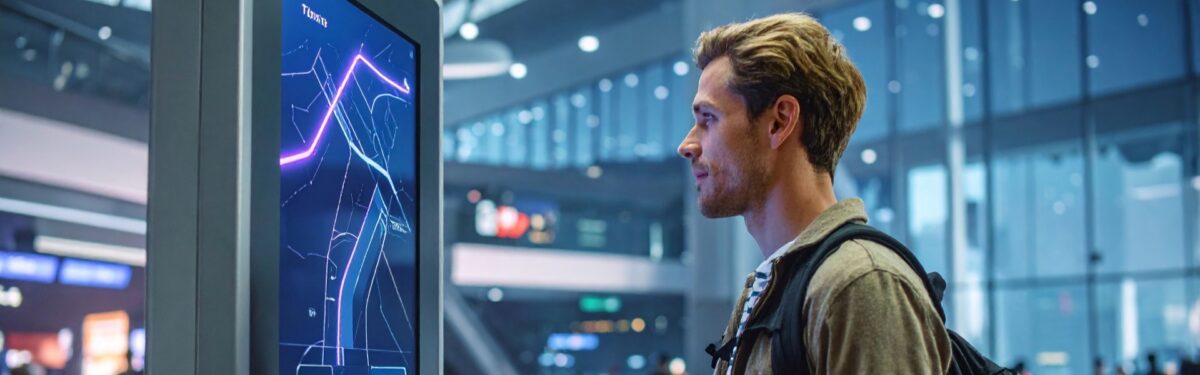
Interactive wayfinding signage is an advanced navigational technology that’s designed to replace static maps and printed directories with dynamic digital displays that respond to a guest’s specific location and destination.
Traditional signage provides a fixed view of a venue’s directions, limited to key landmarks and hotspots. Digital wayfinding systems adjust to a guest’s navigational needs in real time, delivering personalized directions the moment they interface with the system.
The technology behind these systems consists of digital displays, self-service kiosks and mobile-friendly interfaces that work together to guide guests through even the most sprawling venues. For example, a guest can search for food and beverage concessions and receive a clear path forward, without troubling staff or backtracking through unfamiliar hallways.
Some of the most common capabilities of digital wayfinding systems include:
- Interactive maps that visualize the entire property layout
- Turn-by-turn directions tailored to a guest’s current position
- Searchable destinations for rooms, venues and services
- Event and meeting information updated throughout the day
- Amenity directories covering dining, retail and guest services
- Real-time updates that reflect closures, delays or schedule changes
This technology proves valuable anywhere guests must navigate a large or complex property, from hotel properties and convention centers to stadium concourses and casino floors.
Where Does Interactive Wayfinding Make the Biggest Difference?
Expansive venues come with layout challenges, and as intuitive as architects and engineers can be in lessening navigational friction, wayfinding is still a critical component that shouldn’t be overlooked. The impact of interactive wayfinding signage manifests itself in a few key ways across the hospitality industry. Here’s how the technology plays out across different property types.
Hotels
Hotels provide more than just a place for guests to lay their heads. They’re a haven for relaxation and unwinding, and the least amount of stress and mental effort required of guests, the better their experience. Because hotel venues often stretch across multiple wings, towers or floors, it’s easy for guests to lose their bearings. Interactive wayfinding helps guests locate their destination on the premises without wandering hallways or interrupting staff.
Convention Centers
Convention centers come with a unique navigational challenge because schedules and room assignments shift throughout an event. Interactive signage directs attendees to exhibit halls, breakout rooms, registration areas and concessions, so last-minute changes can be made with no disruption. This is especially valuable across large, multi-floor convention centers where a single wrong turn can mean missing part of a session.
Resorts and Casinos
As dynamic properties with entertainment, dining and recreational destinations across sprawling footprints, interactive wayfinding is requisite for resorts and casinos in helping guests navigate all of it with ease. Beyond point A to point B directions, the technology helps guests discover amenities they might not have known to look for, resulting in a more connected guest experience where every part of the property feels within reach.
How Interactive Wayfinding Enhances the Guest Experience
The common denominator behind the guest experience comes down to small moments of ease or frustration, and navigation is one of the biggest factors in play. Recent research reveals that over half (53%) of venue visitors encounter navigation problems, and 77% actively use digital wayfinding systems when navigating a venue (according to Mappedin’s The State of Venue Experience Survey). In turn, interactive signage addresses wayfinding pain points directly and adds value to virtually any large venue, including:
- Faster, Easier Navigation: Guests see clear directions without having to track down a staff member for help. This cuts the time spent searching for rooms, amenities or event spaces and helps first-time visitors feel confident moving through unfamiliar territory.
- Less Friction and Guest Frustration: Interactive signage reduces confusion in large or complicated properties, which helps guests avoid arriving late to meetings, reservations or events. It also gives guests a reliable self-service option when staff members aren’t immediately available. Mappedin’s report found that some properties using interactive wayfinding displays report a 30-40% drop in directional inquiries at staff desks.
- More Personalized Experiences: Guests can search for destinations based on their own needs rather than relying on a single generic map. Interactive systems can also surface relevant amenities or events along the way, creating a more engaging experience than static directional signage.
- Greater Accessibility: Clear visual directions and easy-to-follow navigation help a wider range of guests navigate complex spaces independently. Venues also gain more flexibility in how they present information, adjusting for language, format or accessibility needs.
- Increased Amenity Discovery: Guests exploring a property with interactive maps find it easier to discover restaurants, shops or services they didn’t know were there. Visitors using indoor map tools report finding these hidden amenities up to 62% more easily than guests without them, Mappedin found.
How Does Digital Wayfinding Improve Venue Operations?
Interactive wayfinding is not limited to guest-facing applications; it also simplifies day-to-day operations behind the scenes. Here are some of the ways in which digital wayfinding systems improve venue operations:
- Reduced Routine Guest Requests: Interactive signage reduces the number of basic directional questions asked of front desk, concierge and event staff. This allows employees to spend time on more valuable guest interactions, instead of repeating the same directions all day.
- Dynamic Signage Changes: Rather than changing physical signage when something changes, venue teams can update destinations and information digitally. Directions evolve with changes to rooms, events or venue setups to keep information consistent across all digital touchpoints on property.
- Better Crowd Movement: Digital wayfinding aids in spreading out guests more efficiently throughout large properties, guiding visitors to the right entrances, rooms and amenities. This helps to prevent overcrowding at information desks and other busy areas, particularly at peak times of arrival or during large events.
- Smarter Venue Insights: Interaction data tells us where guests are most likely to search for destinations and where they run into navigation issues. Venue teams can then use wayfinding data as a tool for long-term planning.
- Less Pressure on Staff at Peak Times: Self-service navigation is particularly helpful when properties are at full occupancy and staff bandwidth is limited. Guests who are able to find their way on their own relieve some pressure on teams already juggling check-ins, service requests and event logistics all at once.
Beyond Directions: Additional Uses for Interactive Signage
Digital wayfinding can be leveraged as a powerful guest engagement strategy that extends its utilization beyond functioning solely as a map. Once the infrastructure is in place, venues can explore a range of additional uses, including:
Details About The Event
Interactive displays can offer schedules and session information as well as wayfinding directions, giving attendees one place to reference throughout the day. They can also help direct attendees to upcoming activities as the time of the event approaches. When plans change, venues can pass along updates far more efficiently than reprinting schedules or relying on word of mouth.
Search Amenities
Interactive signage can point out restaurants, lounges, shops and other property features that guests might otherwise walk right past. This helps guests discover services they didn’t even know existed, especially at properties where amenities are spread over multiple floors or wings. It also opens the door to increased use of on-property amenities that might otherwise go underused.
Guest Messaging and Promotions
Interactive displays can serve up relevant property promotions or special events and experiences happening that day. It’s a natural way for venues to provide timely information alongside the navigation guests are already using without feeling like a separate marketing push.”
Emergency and Operations Communication
Interactive signage can provide updated information in real time when normal routes or spaces are unavailable. Venues can rapidly inform about changes in direction for closures, maintenance or unexpected disruptions. This capability complements broader venue communication systems, giving properties another channel to keep guests informed when it matters most.
The Technology That Supports Interactive Wayfinding Signage
Interactive wayfinding signage is an integral part of a larger connected tech ecosystem that keeps venues running smoothly behind the scenes. Digital displays and kiosks need access to current venue and mapping information to remain relevant. And without a steady flow of updated data, even the most state-of-the-art signage systems can wind up directing guests to the wrong room or missing last-minute schedule changes.
Large venues also need infrastructure capable of supporting numerous connected devices and guest-facing technologies simultaneously. Interactive maps, mobile apps and self-service kiosks all draw on shared networks, and a single weak connection point can slow the entire system down. Reliable connectivity keeps these digital experiences accessible and responsive throughout the property. Venues hosting large conferences or conventions face this challenge in an even more concentrated way, particularly when connecting internet for events that bring thousands of connected devices onto the network at once.
Interactive Wayfinding as Part of the Smart Venue
Seldom operated in isolation, digital wayfinding systems are one part of a much larger shift toward smarter, more connected hospitality environments, where technology works together to support guests at every stage of their visit.
Other connected systems may include:
- Digital signage
- Mobile guest experiences
- Smart building technology
- Connected point-of-sale systems
- Guest WiFi
- Operational and Internet of Things (IoT) devices
When these technologies are able to operate on a strong connectivity foundation, venues can create seamless experiences from arrival through departure. A guest might use their mobile phone to check in upon arrival, follow interactive signage to their room, connect to guest WiFi and order from a connected point-of-sale system, all supported by the same underlying network.
This kind of integration is exactly what elevates convention center experiences to a higher level. For more, check out our guide to the anatomy of a smart convention center, which breaks down how these systems work together in practice.
Adopting interactive wayfinding as part of this broader ecosystem is a giant step toward the larger goals every hospitality venue is chasing. That centers on higher guest satisfaction and stronger operational efficiency.
Why Reliable Connectivity Matters for Digital Wayfinding
Even the simplest guest-facing platforms require the right infrastructure behind them. Connected signage, kiosks, mobile experiences and operational systems can all place demands on a venue’s network at the same time, especially during peak occupancy or large events.
Network design determines whether these systems run smoothly or start to lag. Performance matters just as much, since a slow connection can turn an interactive map into a source of frustration rather than relief. Scalability becomes critical as venues add more connected devices, and ongoing monitoring helps teams catch and resolve issues before guests ever notice a problem.
This is where a partner like Cox Business Hospitality can help. Our ecosystem of brands supports hotels and complex venues with the connectivity foundation these guest technologies depend on, so wayfinding, mobile apps and operational systems all have the bandwidth and reliability they need to function as intended. The goal isn’t to sell connectivity as the star of the show. It’s to make sure the technology guests interact with every day actually works the way it’s designed to.
Make Every Guest Journey Easier
Interactive wayfinding signage helps guests navigate large or complex properties with less confusion and fewer interruptions. Whether it’s finding a ballroom, a restaurant or a meeting room, guests get clear directions without needing to track down staff or backtrack through unfamiliar hallways.
The benefit runs in two directions. Guests gain a smoother, more confident experience from arrival to departure, while venue teams gain a more efficient way to communicate information and manage navigation across the property. Fewer routine questions at the front desk and more time for staff to focus on higher-value guest interactions.
Interactive wayfinding is one piece of a much larger opportunity to build a smarter, more connected venue, one where guest-facing technology and operational systems work together on a stable network foundation.
If your property is exploring interactive wayfinding or other guest-facing technologies, connect with Cox Business Hospitality to talk through the connectivity foundation your evolving guest experience strategy will need.