A Guide To Social Media Engagement With Sports Fans In Stadiums

Nothing beats watching a sports game in person. It’s little wonder millions of fans leave the comfort of their homes to swarm stadiums and see their favorite teams play live.

In addition to seeing the game in person, stadiums allow fans to sit next to other fans with similar interests, develop a personal bond with the team, and even access live entertainment options before, during, and after the game. Altogether, stadiums can offer the ultimate fan experience.

As the world embraces large-scale digitization, emerging technologies can even further improve how fans experience live sporting events. To attest to this, a study by Statista showed that an average of 69% of sports fans agree that technology has enhanced their viewing experience.

Social media has now, more than ever, become ingrained within stadium culture. More than just a way to keep fans up to date on team news, social media engagement provides a means by which stadiums can market to and interact with fans for a small cost and a high return on investment.

Why Is Social Media Engagement Important?

In an age where almost everyone is online, social media has become an excellent way for brands and businesses to reach a larger audience. This digital familiarity has led to content saturation, requiring a targeted effort in keeping today’s audience interested and engaged with any piece of digital content.

To navigate this saturation, stadiums need to market and push content effectively. When publishing content to social media, the goal should be for fans to actively engage with your content in the form of likes, comments, shares, or saving the content for later.

Social media engagement, however, is much more than gaining a high following. It’s all about communicating in an online community and building a strong camaraderie with fans via your social channels. Not only do you want your followers to interact with your content, but you also want them to feel as if they are a part of your brand’s story.

5 Effective Marketing Strategies for Social Media Fan Engagement in Stadiums

Social media engagement can serve as a particular boon to stadium-owners. Not only can social media help a brand engage with fans in a stadium, but it can also help a brand to reach users across the globe — leading to even more fans flocking to the stadium in the future.

To help you create a memorable experience, we’ve compiled a list of five of the most successful ways to entertain stadium fans and increase social media engagement at sporting events.

1. Implementing Hashtag Campaigns

One key draw of sports is the sense of community. Sports fans love to talk about the game — whether through cheering on their own team or talking trash about another. Hashtags offer a key way to connect fans by segmenting posts based on specific interests.

With a well-thought-out and branded hashtag, stadium-goers and fans at home get an opportunity to interact with the game in real-time. Posting from the stadium using a hashtag, fans watching the game in-person can share footage of high-octane plays directly from the stadium. This allows fans across the globe to take in stadium views and feel incorporated into the live experience. It also gives the stadium account a way to display what fans are doing across the venue, possibly allowing them to highlight certain concessions stand deals or PR events that other visitors may have been unaware of.

When a unique hashtag is created, users are encouraged to use it while engaging in online discussions along with posting pictures and videos. Eventually, this hashtag may expand beyond the constraints of your own marketing efforts, becoming ingrained in fan culture and driving even more revenue to your stadium.

2. QR Code Implementation

QR codes are another excellent approach to encourage online interactions with stadium fans. Stadiums can place QR codes throughout the venue for visitors to scan and automatically open social media apps such as Twitter and Instagram — giving fans an instant opportunity to share their experience online.

Stadiums should strategically place QR codes throughout the venue at key spots of engagement, such as concession stands or photo opportunity booths. Then, fans can scan the QR code to immediately share their experience. QR codes can even prompt stadium-goers to use a branded hashtag — synergizing your stadium marketing strategy.

3. Sharing Online Polls

As mentioned previously, one thing that makes sports so engaging is the ability to discuss opposite opinions on sporting events. When watching a soccer game, for example, the “Man of the Match” varies greatly depending on who you ask. Fans are passionate about these issues, and will jump at the opportunity to share their opinions.

Online polls on social media give fans a more objective way to discover the majority opinion among their peers. Polls can ask targeted questions to stadium-going fans — possibly prompting an in-person debate and rallying fans to encourage others to vote and prove their point.

Online polls are also great for feedback. Stadium-planners can use them to get suggestions, or ask fans about certain stadium features. By engaging in feedback, fans feel like they are a part of a larger community within the stadium as a whole, which works to help increase their investment in the team and drive a positive association with their visit to the venue.

4. Personalized Interactions With Fans Across The Globe

Personalized social media interactions go a long way in improving the stadium experience and subsequently reaching fans anywhere they are in the world.

Because not all fans can attend events in-person, it is important to make sure that your stadium extends its social media presence beyond the venue itself. To do this, there are many tactics the stadium can take to incorporate at-home fans into the experience, such as hosting a live stream where stadium representatives or sports announcers read off Tweets and questions from users in real time.

Additionally, social media can help replicate the environment of the stadium by prompting fans to participate in virtual challenges, utilize image filters, or engage with the stadium’s social channel to possibly win branded prizes. There is also an opportunity to display at-home fans social media images of the game on an in-stadium display and live broadcast.

Simple interactions like these help to establish a positive association with a business and build an online community. As your stadium builds a reputation for personalized engagement that extends beyond its walls, more fans will flock both to your social page and your in-person venue.

5. Potential To Be Featured On A Stadium Screen

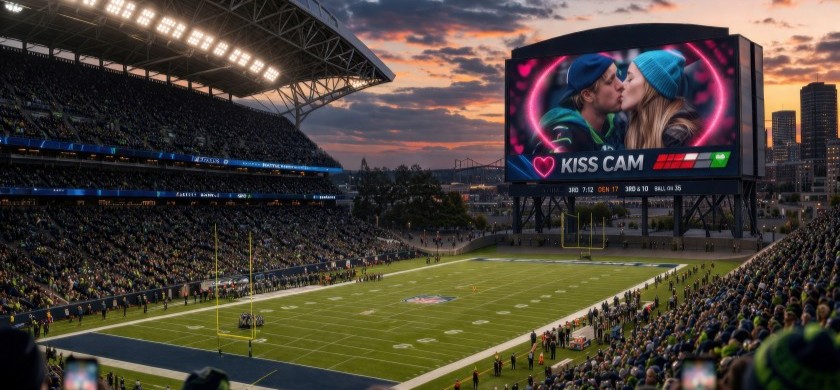
From kiss-cams gone wrong to dance battles, fan camera videos from sporting events go viral all of the time. Fans and online users alike love to watch the spontaneity of an event-goer acting humorously on camera.

Capturing fans in the stadium doing exciting activities and sharing those moments in real time via social media can be a great way to drive fan engagement. By posting online using hashtags and tagging stadium accounts, fans can connect with stadiums to feature themselves on the big screen. Once featured, fans can share that those moments made the big screen — offering yet another opportunity for online fan engagement.

Stadiums should also focus on creating activities people can easily engage with. Stadium screens can be used to pay tribute to long-time match attendees, wish a fan a happy birthday, or get the audience to engage in an in-person game. Whatever the tactic, fans will happily engage in a unique digital experience within your stadium.

Drive Fan Engagement in Stadiums With Hospitality Network

A great stadium experience boosts fan engagement, especially when using effective social media strategies. In order to implement these strategies and give fans a flawless digital experience, however, stadiums need reliable internet connectivity to allow visitors uninterrupted access to social media.

Hospitality Network offers cutting-edge WiFi solutions and internet connectivity that help revolutionize the fan experience while assisting today’s modern stadiums in providing a higher degree of fan engagement. Reach out to us today for powerful networks and world-class implementation that drives fan engagement in stadiums.

Stadium Connectivity Solutions: Managed WiFi, Private Wireless or Distributed Antenna Systems (DAS)?

Modern stadiums and arenas have transformed into sophisticated digital ecosystems where connectivity infrastructure directly impacts fan experience, operational efficiency and revenue generation. As tens of thousands of fans rely on mobile devices for sharing, ticketing, concessions and streaming, strong stadium connectivity is essential. Smooth performance boosts the fan experience, while failures create frustration that can hurt season-ticket renewals, reduce repeat attendance and ultimately impact the venue’s reputation. Peer-reviewed research further shows that when fans perceive the in-venue experience as outdated or frustrating, attendance declines and renewal behavior suffers, underscoring how inadequate digital infrastructure can directly erode long-term fan retention.1

Stadium WiFi, private wireless and distributed antenna systems (DAS) each support different parts of today’s venue connectivity challenges. Choosing the right mix for your stadium’s capacity, event types and operational needs is critical for facility managers and IT leaders planning for the digital future. Each technology plays a distinct role. They deliver high capacity, low latency and mission-critical performance when they’re designed to work together, making coordinated expertise essential.

Understanding Your Connectivity Options

Managed WiFi Solutions

Managed WiFi represents the foundation of stadium connectivity, providing internet access through strategically deployed enterprise-grade wireless access points throughout the venue. These systems can be managed internally or through external service providers specializing in high-density environments.

Key advantages include: 

  • Scalable capacity management for varying event sizes
  • Guest network segmentation for security and performance
  • Real-time analytics for crowd management and operational insights
  • Rapid deployment with existing infrastructure integration
  • Cost-effective coverage for most stadium applications
  • Customizable access portals for branding and fan engagement

Managed WiFi excels in supporting core stadium applications including mobile ticketing systems, social media engagement, concession ordering apps and general internet access. Modern stadium WiFi systems can handle thousands of concurrent users per section when properly designed with high-density access points and adequate backhaul capacity.5

Private Wireless Networks

Private wireless networks, including Citizens Broadband Radio Service (CBRS) and dedicated spectrum solutions, create venue-specific cellular networks independent of public carrier infrastructure. These systems can provide improved performance and enhanced security for mission-critical stadium operations.

Primary benefits include: 

  • Dedicated bandwidth unaffected by external network congestion
  • Enhanced security for sensitive operations and financial transactions
  • IoT device connectivity for smart stadium systems
  • Ultra-low latency for real-time applications and emergency services
  • Carrier-grade reliability with built-in redundancy systems
  • Support for both public safety and commercial applications

Private wireless networks prove invaluable for supporting critical stadium IoT infrastructure including security camera networks, environmental control systems, digital signage, point-of-sale systems and broadcast equipment. These networks also excel during peak usage periods when public cellular networks become congested.

Distributed Antenna Systems (DAS)

Distributed antenna systems improve cellular coverage and capacity by distributing carrier signals through networks of strategically placed antennas. DAS boosts cellular service rather than providing WiFi. In spectrum-constrained stadiums, tens of thousands of devices compete for bandwidth, and WiFi alone can’t handle all fan traffic. Public cellular adds essential licensed spectrum, helping ensure reliable performance during peak moments like touchdowns and halftime.

Core advantages include: 

  • Comprehensive cellular coverage eliminating dead zones
  • Multi-carrier support for all major wireless providers
  • High-capacity handling during sold-out events
  • Improved emergency communications for public safety compliance
  • Long-term infrastructure investment with extended lifecycles
  • Support for evolving cellular technologies including 5G

DAS systems become essential in large stadiums where structural materials, crowd density and venue design create cellular coverage challenges.6 These systems support reliable voice communications for emergency services and enhance fan experience by maintaining cellular connectivity throughout the venue.

How WiFi, Private 5G and DAS Can Work Together

A modern stadium network is not a WiFi vs. 5G decision. It’s a layered architecture, with each technology serving specific needs. When integrated correctly, these networks complement rather than compete, helping to create a frictionless environment for both fans and stadium operators.

WiFi: High-capacity fan connectivityPrivate 5G: Operational backboneDAS (Public Cellular): Carrier-grade fan capacity
Supports (e.g.):  
– Apps  
– Social sharing  
– Streaming  
– Ticketing  
– Concessions/Mobile Concessions
Supports (e.g.):  
– Staff communications  
– POS systems  
– Security systems  
– Access control  
– Broadcast & media operations
Supports (e.g.):  
– Fans using carrier networks
– High-demand mobile moments  
– Licensed-spectrum reliability
– Emergency Services Coverage

Matching Solutions to Stadium Size and Needs

Small Stadiums (Under 25,000 Seats)

Small stadiums and arenas typically benefit most from managed WiFi solutions as their primary connectivity infrastructure. These venues, including minor league ballparks, college basketball arenas and soccer stadiums, require reliable connectivity without the complexity of larger venue systems.2

Recommended approach: 

  • Deploy high-capacity WiFi access points in seating areas and concourses
  • Implement scalable bandwidth that can adjust for different event types
  • Focus on essential applications like mobile ticketing and concessions
  • Consider cloud-managed solutions for simplified operations
  • Plan for peak capacity during championship games or special events

Small stadiums should prioritize reliability and cost-effectiveness while ensuring adequate capacity for sellout crowds. A well-designed managed WiFi system can support typical fan connectivity needs while providing operational benefits for staff communications and venue management.

Medium Stadiums (25,000-65,000 Seats)

Medium-sized stadiums often require hybrid connectivity approaches combining robust managed WiFi with supplementary solutions. These venues, including many college football stadiums and professional arenas, host diverse events with varying connectivity demands.

Strategic considerations: 

  • Implement enterprise-grade managed WiFi as the connectivity foundation
  • Evaluate private wireless for critical operations and IoT systems
  • Assess cellular coverage quality and consider DAS for problem areas
  • Design network segmentation for different applications and security levels
  • Plan for diverse events including concerts, graduations, and sporting events

Medium stadiums benefit from flexible infrastructure that can adapt to different event types while maintaining consistent performance during peak usage periods.2 These venues often serve as testing grounds for emerging fan engagement technologies.

Large Stadiums (Over 65,000 Seats)

Large stadiums typically require comprehensive connectivity portfolios incorporating managed WiFi, private wireless capabilities and robust DAS infrastructure. These large-scale venues, such as top professional and major collegiate football stadiums, stand at the forefront of modern technology integration.

Infrastructure requirements: 

  • Ultra-high-density managed WiFi with extensive access point deployment
  • Private wireless networks for mission-critical applications and extensive IoT systems
  • Comprehensive DAS systems ensuring cellular coverage throughout the venue
  • Network redundancy and failover capabilities for uninterrupted service
  • Advanced analytics and monitoring systems for real-time optimization
  • Dedicated IT support teams and managed service partnerships

Large stadiums must treat connectivity as critical infrastructure requiring significant investment and specialized expertise to meet the demands of massive concurrent usage during major events.

When to Choose Combination Solutions

Many stadiums rely on a mix of connectivity technologies to support different operational needs.  A hybrid approach becomes especially valuable when:

  • Diverse Event Portfolio: Venues hosting professional sports, concerts, corporate events and community gatherings require different connectivity capabilities for varying audience sizes and technical requirements.
  • Operational ComplexityStadiums with extensive IoT deployments, including smart lighting, HVAC systems, security networks and digital signage, benefit from pairing private wireless for operations with WiFi for fan access.
  • Peak Capacity Management: Venues that see dramatic differences between regular season crowds and playoff or special events need scalable solutions that handle peak loads without overspending on everyday capacity.
  • Emergency Preparedness: Large venues must support reliable emergency communications, often requiring DAS to meet local public safety and first‑responder requirements.3

Stadium-Specific Connectivity Challenges and Solutions

Game Day Traffic Spikes

Stadium connectivity faces unique challenges with massive, simultaneous usage spikes as tens of thousands of fans enter venues within short timeframes. Unlike conference centers with gradual arrivals, stadiums experience extreme traffic bursts during key moments like halftime, touchdowns or between innings.4

Solution approaches: 

  •  Load balancing across multiple network technologies
  •  Predictive capacity scaling based on game situations
  •  Network prioritization for critical applications
  •  Real-time monitoring and automated adjustments

IoT Integration and Smart Stadium Systems

Modern stadiums are increasingly relying on Internet of Things devices for operational efficiency and fan experience enhancement. These systems include mobile ticketing platforms, cashless concession systems, environmental controls, security camera networks, digital wayfinding and emerging technologies like augmented reality experiences.

Key connectivity needs include: 

  •  Dedicated network segments for different IoT applications
  •  Low-latency connections for real-time systems
  •  Secure communications for financial transactions
  •  Reliable connectivity for safety and security systems

Regulatory Compliance and Emergency Communications

Stadiums must comply with various regulatory requirements, particularly regarding emergency communications. The FCC’s Communications Security, Reliability and Interoperability Council (CSRIC) provides guidelines for public venue communications, while local authorities often mandate specific emergency communication capabilities.3

Compliance considerations: 

  • FirstNet compatibility for emergency responders3
  • Backup power systems for critical communications
  • Priority access for emergency services
  • Regular testing and certification requirements

Seasonal and Event Variability

Unlike year-round conference facilities, many stadiums experience significant seasonal usage variations and diverse event types requiring different connectivity approaches.

Adaptive solutions:

  • Flexible bandwidth allocation for different event types
  • Seasonal capacity adjustments for weather-dependent venues
  • Multi-purpose network design for sports, concerts, and community events
  • Cost-effective scaling for varying usage patterns

Operational Efficiency and Effectiveness Benefits

Enhanced Fan Experience

Reliable stadium connectivity directly impacts fan satisfaction and loyalty. Seamless WiFi enables social media sharing of memorable moments, mobile app interactions, digital ticketing and cashless transactions. These capabilities create more engaging experiences while generating valuable data for marketing and operational improvements.

Revenue Generation Opportunities

Advanced connectivity infrastructure can unlock new revenue streams by enabling premium WiFi tiers, supporting enhanced mobile app engagement, powering location-based marketing and delivering immersive digital experiences.7 Stadiums with robust connectivity can also attract high-value corporate events and serve as venues for esports tournaments and digital entertainment.

Operational Intelligence

Modern connectivity systems can also offer insights into how fans move through a venue, how crowds form and how different areas of the facility are used. This data enables optimized staffing, improved security management and data-driven decisions for future infrastructure investments and fan experience enhancements.

Safety and Security Enhancement

Robust connectivity infrastructure supports comprehensive security systems including surveillance networks, access control systems and emergency communication capabilities. These systems improve overall venue safety while helping to ensure compliance with regulatory requirements.

Implementation Considerations

Capacity Planning for Peak Events

Research shows that stadiums must design wireless networks for peak-demand scenarios, as major events like championship games and other largescale gatherings generate extreme, high-density connectivity loads.4 Design for worst-case scenarios while considering background traffic from operational systems, broadcast equipment and staff communications.

Network Segmentation and Security

Implement comprehensive network segmentation separating fan access from critical operational systems. Consider PCI compliance requirements for payment processing, regulatory requirements for emergency communications and security protocols for broadcast and media operations.

Weather and Environmental Factors

Outdoor and retractable-roof stadiums face additional connectivity challenges from weather conditions, temperature variations and environmental factors affecting equipment performance and signal propagation.

Integration with Existing Systems

Evaluate connectivity solutions for compatibility with existing ticketing systems, point-of-sale networks, security infrastructure and broadcast equipment.5 Design new implementations enhance rather than disrupt current operations.

Future-Proofing Your Stadium Connectivity

Emerging Technologies

Plan for emerging applications including 5G integration, edge computing capabilities, virtual and augmented reality experiences and advanced analytics platforms.6 Consider bandwidth requirements for ultra-high-definition video streaming and immersive fan experiences.

Scalability and Growth

Choose solutions that can grow with evolving technology demands and changing fan expectations. Consider modular deployment approaches that allow incremental capacity increases and technology upgrades.

Vendor Partnership Strategy

Evaluate connectivity providers based on stadium-specific expertise, 24/7 support capabilities, scalability options, emergency response protocols and experience with high-density venue deployments.2

Maximizing Your Stadium Connectivity Investment

The most successful stadiums view connectivity infrastructure as a strategic asset that enhances fan experience, improves operational efficiency and creates new revenue opportunities. By selecting the right combination of managed WiFi, private wireless and DAS solutions, venues can create competitive advantages that drive attendance, fan loyalty and financial performance.

Why Coordinated Engineering Expertise Matters

The future of stadium connectivity isn’t WiFi vs. private wireless vs. DAS, it’s strategically integrating all three. Operators need partners who understand how these technologies intersect and how to optimize them for massive crowds, mission-critical operations, and next-generation fan experiences. WiFi must support high-density throughput, private wireless must secure mission-critical functions and public cellular must deliver carrier capacity during peak moments. These systems reach full value only when planned and managed holistically.

This requires specialized experience across multiple network disciplines, and this is where Cox Hospitality Network and Cox Private Networks bring unique value as our teams understand each technology deeply and know how to integrate them into a single, cohesive stadium connectivity strategy.

With proven success in stadium environments and expertise in handling massive concurrent usage demands, Cox Business provides the infrastructure, support and specialized knowledge needed to keep your fans connected and your operations running smoothly.

Connect with us to explore a purpose‑fit connectivity strategy for your stadium.

Works Cited

1.  Levallet, Nadège, and Norm O’Reilly. Enhancing the Fan Experience at Live Sporting Events: The Case of Stadium Wi‑Fi. Case Studies in Sport Management, vol. 8, 2019, pp. 6‑12. https://www.researchgate.net/profile/Michael-Naraine/publication/332650064_Enhancing_the_Fan_Experience_at_Live_Sporting_Events_The_Case_of_Stadium_Wi-Fi/links/609c29bd299bf1259ecd6b04/Enhancing-the-Fan-Experience-at-Live-Sporting-Events-The-Case-of-Stadium-Wi-Fi.pdf

2.  International Association of Venue Managers. “Technology Trends in Sports Venue Management.” IAVM Publications, 2023. https://www.iavm.org/

3.  Federal Communications Commission. “Communications Security, Reliability and Interoperability Council VII Report.” FCC CSRIC, 2023. https://www.fcc.gov/about-fcc/advisory-committees/communications-security-reliability-and-interoperability-council

4.  Pennington, G. (2026). How Hard Rock Stadium’s venue‑specific wireless technologies elevated the fan experience at the CFP National Championship. LinkedIn. https://www.linkedin.com/pulse/how-hard-rock-stadiums-venue-specific-wireless-fan-cfp-pennington-lzbse/

5.  Cisco Systems. “Connected Stadium Wi-Fi Solution Design Guide.” Cisco Networking Solutions, 2023.  https://www.cisco.com/c/en/us/solutions/industries/sports-entertainment.html

6.  Wireless Infrastructure Association. “DAS and Small Cell Deployment in Sports Venues.” WIA Research, 2023. https://wia.org/

7.   Alepo. (2025). WiFi monetization: Transform WiFi infrastructure into revenue streams [Datasheet]. Alepo. https://www.alepo.com/wp-content/uploads/2025/09/Datasheet-WiFi_Monetization.pdf

How AI is Impacting Sports—From Stadiums to Strategy

Learn Why AI In Sports Stadiums Is Essential For 2026

Artificial intelligence is everywhere. A 2025 report from McKinsey found that 88 percent of survey respondents reported regular use of AI in at least one business function, with that number only set to grow.

The world of sports is no exception to this trend. From how teams scout talent and prepare for opponents to how fans navigate stadiums and order concessions, AI is quietly reshaping every layer of the industry.

As leagues, franchises and venue operators look ahead to 2026, the question is no longer if AI will impact sports, but how deeply it will be embedded into strategy, performance and the live event experience. Below, we explore the most important ways AI is transforming athletics—from on-field decision-making to in-stadium innovations that redefine what fans expect on game day.

What is AI in Sports?

AI in sports uses advanced data analysis and automated technologies to improve how games are played, managed and experienced. By processing information such as player performance metrics, wearable sensor data, video footage, and fan behavior, AI uncovers patterns that would be difficult to identify manually, helping teams make better decisions about recruiting, game planning, training and officiating

Beyond the field, artificial intelligence also powers smarter stadium operations through personalized mobile apps, enhanced security, reduced congestion at concessions and restrooms, and interactive fan experiences—making AI a growing standard for both modern sports strategy and venue management.

How is AI Being Used in Sports? Key Examples

Nearly every facet of sports is being impacted by AI, and experts are taking notice.

“AI has been a godsend for sports in many ways,” explains Craig Esherick—Academic Program Coordinator at the George Mason College of Education and Human Development—in an interview with the college

As with any new technology, Esherick explains, “you do need to be trained, and you do need to understand numbers and how to analyze data in order to do it effectively.” But as AI expands its capabilities, so too does it expand its utility for all kinds of sports professionals with the proper training. Here are just a few of the most essential means that AI is impacting sports.

Integrated AI Data Insights & Sports Analytics

Data analytics and artificial intelligence have worked hand-in-hand since the first adoption of the technology. AI can help detect more subtle or complex patterns within data-sets, working in tandem with human analysis to achieve otherwise inaccessible results. 

This high-level analysis also translates to data analytics within the world of sports. Examples of key data insights within sports analytics include:

  • Data-Driven Team-Building: Recruiters and general managers alike can use AI to dive into data sources to determine which players fit the unique system they’re trying to run.
  • Integrated Game-Planning: AI helps analyze opposing team and player tendencies to help gameplan specific strategies to turn opponent strengths into weaknesses.
  • Player Performance Analysis: Combining historical data with wearable sensors that track real-time results, predictive models can tell which areas a player excels and how they can improve.
ai in sports training and equipment

AI-Enabled Training Equipment

Player performance analysis goes beyond onfield results; using data analytics gleaned from artificial intelligence, athletic trainers can optimize performance plans for their athletes to stay at the top of their game and avoid hurting themselves.  

“(AI has) provided people jobs,” explains Esherick, “that can show athletes how to train intelligently, to prevent fatigue, to prevent injury, but also to increase performance.”

A key means to track how training impacts athletic performance is through AI-enabled training equipment. Integrated treadmills, watches, sensors, and weights can sense which muscles need the most work, what type of activity places the most stress on athletes, and how much weight athletes really need to improve sustainably—all leading to more effective, targeted training plans.

AI-Assisted Officiating & In-Game Reviews

While still a work in progress, AI may some day even be making all the calls across sports viewing experiences.

“We’re not there yet, but,” explains Esherick, “the next iteration of AI in sports could be replacing the umpire behind home plate that can determine the differences between balls and strikes.”

Whether by replacing them entirely or acting as a key support, AI integration within officiating can help make far more precise calls, alleviating fan stress and reducing pressure on referees to make the right call amidst intense in-game action.

AI For Sports Stadiums: Exciting Innovations

Innovations in artificial intelligence for sports don’t stop at players, trainers and coaches; AI holds immense value to improve stadium experiences for fans and employees alike. While AI reimaginings of NFL stadiums may steal headlines, artificial intelligence also has far more practical uses changing the game for sports venues. Here are few of the most exciting innovations being adopted in the world’s most cutting-edge arenas.

Personalizing Content Within Stadium Apps

Many modern stadiums—including the popular Las Vegas Ballpark in Downtown Summerlin, Nevada—integrate stadium apps within their fan experiences to put multiple facets of their venue at attendee fingertips. Artificial intelligence can help synthesize fan tendencies within these apps to present personalized, relevant content every time they log on. 

Some examples of personalized content include:

  • Mobile Stadium Ticketing: Promote additional future events for fans that they’re likely to convert on using previous event buying patterns within ticketing pages.
  • Targeted Digital Wayfinding: Suggest and direct fans toward stadium features in line with previous positive rate experiences within an arena.
  • Timed Food Suggestions: Send push notifications for concessions scheduled based on when and where fans have previously ordered food over the course of a game.

Personalized content like these innovations can lead to a higher chance of future fan conversions and upsells, continuously increasing the return on investment of stadium apps as further data gets integrated.

AI-Integrated Security Features

IoT technology has helped upgrade stadium security for the better part of a decade, and artificial intelligence continues to help increase safety for fans as they enjoy their favorite teams. Key artificial intelligence integrations within stadium security include:

  • Streamlined, Efficient Entrance Surveillance: Track crowd density using automated sensors to detect bottlenecks and track faces of known threats to halt them from getting anywhere near inside a venue.
  • Predictive Inclement Weather Forecasts: Use weather sensors connected to predictive systems to identify threats of thunderstorms and give fans a more accurate idea of when a storm may pass.
  • Non-Stop, Automated Network Tracking: Artificial Intelligence monitors stadium networks for abnormalities and potential cyberattacks, alerting admins of hackers and bad actors before they can affect stadium experiences.

Using these AI integrations and more, stadiums can build a holistic means to keep fans safe, no matter what risk factors come into play.

ai innovations in sports stadiums

Concession Stand Monitoring

The same technology used to track crowd density at admission can be implemented to track congestion at other key venue touchpoints, including concession stands. 

For both concession stands and bathrooms, one example of this technology is WaitTime. This technology tracks organic crowd movement in areas with high ceilings to read different crowd conditions, transmitting information directly to visitor-facing components featuring estimated wait times for every concession stand within your venue.

Interactive Jumbotron Displays

Besides these ways to optimize efficiencies across several aspects of a stadium, artificial intelligence can flat out help fans have more fun. Using scannable QR codes, fans can submit pictures from their game experience for rapid, goofy edits from artificial intelligence, leading to interactive moments including:

  • Superfan Transformations, decking fans with even more gear and face make-up.
  • Cartoon Morphs, transforming fans into characters from their favorite properties.
  • Superhero Edits, giving fans super-powered alter-egos ready to save the day.
  • Mascot Mash-Ups, posing fans with team mascots if they can’t find them in-stadium.

The possibilities of these AI-integrated Jumbotron displays are endless, only limited by the creativity of a stadium’s events team.

Hospitality Network: Your Key Partner for AI Stadium Innovation

AI is rapidly becoming the backbone of modern sports operations and stadium experiences. As these technologies grow more sophisticated, one reality becomes clear: AI is only as powerful as the digital infrastructure supporting it.

That’s where Hospitality Network stands apart. As a trusted provider of high-performance connectivity for stadiums and large venues, Hospitality Network designs and deploys the stadium networks that AI systems depend on to function in real time. From supporting data-heavy analytics platforms and IoT security tools to powering personalized stadium apps and interactive fan experiences, Hospitality Network ensures that AI integrations are fast, reliable, and scalable.

Contact us today to learn how we can help support all kinds of technology within your stadium—from IoT connectivity to next-generation artificial intelligence.

Internet for Events: Build a Foundation for Seamless Experiences

Why Event Internet Services Matter More Than Ever

In today’s event landscape, internet connectivity is the backbone of the entire guest experience.

From livestreaming and interactive apps to IoT-powered security and immersive AR activations, nearly every aspect of modern events depends on a reliable, high-capacity network.

To keep pace with rising expectations and cutting-edge industry technology, organizers need event networks designed to handle evolving demands.

Read on to learn about the specific pieces of technology making event internet services more essential than ever and common network pitfalls to avoid.

Why Does Wireless Internet for Events Matter Now More Than Ever?

Event guests expect instant, always-available connectivity. Whether they’re streaming, engaging through apps, or exploring immersive AR and VR activations, reliable wireless internet is essential for guests. 

Event organizers, meanwhile, rely on connected tools for analytics, operations, and security. With this dual demand from both guests and staff, a dependable event internet network is critical to delivering seamless experiences.

Exciting New Pieces of Event Technology Reliant on Event Networks

Powerful wireless internet supports innovations built for event guests and venue personnel alike. Pieces of technology must-haves that depend on event networks include, but are not limited to:

  • Extended Reality Event Experiences: Virtual Reality (VR) and Augmented Reality (AR) experiences leverage internet connections to access immersive guest experiences.
  • IoT Connected Event Security: Both physical and cybersecurity innovations rely on wireless network access.
  • Audience Engagement Tools: Online-connected engagement tools gather information via hybrid Q&A sessions, audience engagement polls, and more.
  • Integrated AI Experiences: Guests can engage with online support chatbots, while event organizers can access online databases built for comprehensive analytics.

Wireless internet access is and will continue to be crucial. It’s up to your event team to find a network provider that can support your future.

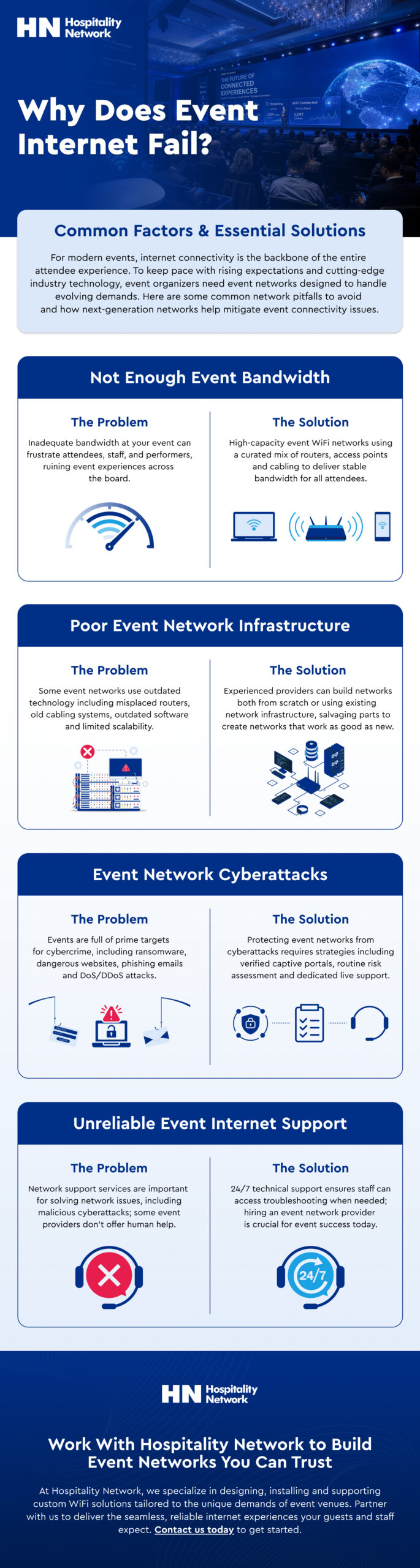
Why Does Event Internet Fail? Common Factors & Essential Solutions

Event internet fails for a variety of reasons, from installation issues to overuse or even bad actors. Proactive solutions may include:

  • High-density WiFi design
  • Infrastructure upgrades
  • Advanced cybersecurity measures
  • 24/7 support 

Transform vulnerable event networks into reliable, future-ready systems with these solutions. Below, learn more about some of the common causes for event inherent failure and how to solve them.

Not Enough Event Bandwidth

Due to high volume network needs, it can be tricky to implement the necessary bandwidth to support all devices at large events. Here’s a quick breakdown of how bandwidth works:

  • Bandwidth is measured in Mbps, or megabits per second
  • Mbps is a measurement that analyzes the amount of data that can travel between two points within a network at any given second
  • When the devices in your network transmit more Mbps than your network can handle, data information transfer in your network slows down.

Think of data like water in a pipe. As long as the volume of water flowing through your pipe remains below a certain level, your pipe should run smoothly. Once the water exceeds that level, however, your pipes will slow down or burst. The same logic applies to data and bandwidth.Once data on your network exceeds your network’s Mbps, your network’s “pipe” will struggle to transmit data at an effective rate.

With big crowds, innovative devices, and multi-device livestreams, events are at particular risk of not having enough bandwidth. Unsuitable bandwidth at your event can frustrate attendees, staff, and performers, ruining event experiences across the board.

How to Solve Low Bandwidth Event Networks

High-capacity (also known as high-density) event WiFi networks solve issues with low-bandwidth within your event venue. 

These networks are built specifically to sustain the needs of densely-populated event networks, using a curated mix of routers, access points, and cabling installed specifically for your venue’s layout. 

Skilled event network providers will identify your venue’s exact needs, building specific solutions tailored for your events.

How to Solve Low Bandwidth Event Networks

Poor Event Network Infrastructure

Low bandwidth is often a side effect of a poor overall event network infrastructure. Many event networks are built using technology that was once modern but has grown outdated through years of neglect and unadapted innovation. Poor pieces of event network infrastructure commonly found in venues include:

  • Misplaced routers located in spots prone to spotty network access, whether due to poor initial placement or new construction.
  • Old cabling systems, non-compliant with current industry standards and incompatible with latest network technologies.
  • Outdated software that’s missing essential software updates or lacking continuous, current support.
  • Limited scalability due to poor network foundations and a lack of response plans in case of full network crashes.

How to Solve Poor Event Network Infrastructure

Hiring an event WiFi provider specialized in building durable, adaptable networks is the key to fixing event network infrastructure. Experienced providers can build networks both from scratch or using existing network infrastructure, salvaging parts to create networks that work as good as new. 

Event network standards are continuously growing in scope and speed. Good providers also know how to build infrastructure scalable for the future. 

Event Network Cyberattacks

Even networks with powerful bandwidth and rock-solid infrastructure can face massive slowdown and complete failure due to cyberattacks.The cost of cybercrime is expected to rise to nearly $24 trillion by 2027, and events are full of devices primed for targeting. Cybercrime takes all kinds of forms, including: 

  • Ransomware software that prevents event attendees from accessing essential technology solutions until users pay a ransom to bad actors.
  • Dangerous websites disguised as trustworthy, leading to fraudulent pop-up ads and forced, dangerous downloads.
  • DoS and DDoS attacks designed to overwhelm system resources and disrupt provider abilities to respond to real service queries.
  • Phishing emails, messages, and network log-ins built to socially engineer fake scenarios where attendees may give up valuable information.

How to Counter Event Network Cyberattacks

Protecting your event network users from cyberattacks requires a diligent, constantly evolving commitment to your event network cybersecurity. Just as bad actors are always searching for new ways to attack your users, event network providers must continuously search for innovative methods to counter these attacks. Recent solutions that are absolute necessities for network cybersecurity include:

  • Verified captive portals that present terms & conditions pages and email address sign-on to networks, tracking network use and keeping out bad actors.
  • Restricted access to dangerous websites using DNS (Domain Name System) filtering.
  • Thorough risk assessment of incidents at similar events, high-risk individuals, and potential security compromises to avoid.
  • Dedicated live resources that monitor network performance and abnormalities, ready to proactively stop potential sources of danger.

Unreliable Event Internet Support

Network support services are important for solving network issues, from malicious cyberattacks to less sinister slowdowns. Some event WiFi providers fail to offer access to human help or phone support lines, instead relying on online frequently asked questions (FAQ) pages. If a network question isn’t answered on that page, event organizers using these providers are out of luck.

How to Solve Unreliable Event Internet Support

Across event-planning and the events themselves, event network support is often required at all times of day. 24/7 technical support ensures your event staff can access troubleshooting whenever it’s needed. Hiring an event network provider that offers this type of support is crucial if you want holistic, constantly reliable network access.

How to Solve Unreliable Event Internet Support

Work With Hospitality Network to Build Event Networks You Can Trust

Every successful event rests on a foundation of strong, dependable connectivity. At Hospitality Network, we specialize in designing, installing, and supporting custom WiFi solutions tailored to the unique demands of event venues. From high-capacity bandwidth and IoT-ready infrastructure to advanced cybersecurity and round-the-clock technical support, our solutions ensure your event network performs when it matters most. Partner with us to deliver the seamless, reliable internet experiences your guests and staff expect. Contact us today to get started. 

Top 10 Technology Must-Haves for Modern Events

Modern event guests expect seamless, connected, and memorable experiences powered by technology. From smarter concession solutions to AI-driven personalization, today’s event tech sets the stage for efficiency, engagement, and excitement.

Stadium Tech Trends and the Future of the Football Fan Experience

Even though it is off-season, it’s time for stadiums to make some upgrades in anticipation of the new season. To offer the best stadium experience, arenas need to stay at the cutting edge of technology. That means incorporating the latest advances in fan experience.

Need help staying ahead of the new stadium technology trends? Read on below to discover what trends are predicted to dominate smart stadium design.

Managed WiFi for World Class Stadiums

A cutting-edge WiFi network serves as the backbone of any smart stadium experience. Fans have come to expect wireless internet connection at football and sports games. Wireless connection allows access to a whole suite of apps, social content, and more. Without reliable connectivity, many features that excite fans about smart stadiums can become tedious, frustrating chores.

Because stadium networks need to support tens of thousands of devices, maintaining stadium internet connectivity is no small task. Dedicated stadium WiFi management, like the solutions provided by our team, help keep stadiums online through the biggest games.

Several trends in smart stadium technology tie directly to network connectivity. High-bandwidth WiFi opens the doors to each of these opportunities, allowing for innovation.

Connected, Interactive Social Sharing

Fans love to boast their team pride and show off stadium experiences on social media. High-speed WiFi in stadiums allows fans to share their favorite memories in real-time. From exciting moments like game-winning plays to unexpected bonding amongst rival supporters, wireless connection gives fans every opportunity to go viral.

Smart stadiums can even leverage social media as a substantial part of their fan experience. By implementing hashtags and monitoring social activity, stadiums can track engaging social content from fans. Stadiums can then display hot posts on designated digital signage throughout the stadium. Top content can even make it to the main stadium display, letting the entire arena share the moment.

Well implemented social sharing keeps fans involved and gives them a hands-on way to control the stadium experience. Without internet connectivity, fans lose out on these community-building experiences.

Immersive Virtual Fan Experiences

Virtual experiences add another layer of engagement for all kinds of football fans. Through downloadable AR apps, stadium spectators can view the field with engaging information overlays. These fan experience apps offer a unique mixed reality experience.

Overlays can include in-depth game statistics, instant replays of contentious calls, and in-depth analysis to satisfy hardcore fans. Or, for more casual spectators, augmented reality can entertain by projecting more fantastical animations.

Instant Access to Stadium Concessions

In tight games, fans rarely want to leave their seats to get concessions. Online concession sales solve this problem and keep food revenue flowing throughout the game. By connecting to fan experience software like a website or app, ordering food and drinks online is a simple and painless process that helps prevent fans from missing any unforgettable gameplays.

Connected concession sales also help make it easier to analyze data. Online tracking lets stadium owners know when and what fans want to eat and drink at any point of the game, which can be leveraged to help optimize concessions offerings and increase ROI.

Contactless Stadium Experiences

Contactless stadium experiences have rapidly risen in both popularity and mainstream use. With advances in RFID and NFC technology, guests can now enter stadiums, pay for concessions, and interact with stadium experiences without touching a single part of the physical stadium.

In turn, contactless technology lets guests interact with stadiums on their own terms. Stadium surfaces may be touched by hundreds, sometimes thousands of spectators at every event. By integrating contactless access, guests who prefer to avoid those surfaces can — while more traditional guests can do things the old-fashioned way.

These experiences also allow for greater guest convenience. With holistic, contactless access to every aspect of the stadium, fans that choose contactless options won’t have to worry about carrying cash, credit cards, or paper tickets. Instead, they can access everything they need from their smart devices. Speaking of which…

Convenient, Comprehensive Wearable Devices

Wearable devices offer yet another alternative to traditional ticketing and concession technology. Through accessories like smartwatches, stadium guests can access all contactless experiences, including their tickets, wallet, and more.

These devices offer even further convenience compared to other smart devices, as they’re immediately accessible. Guests don’t even need to take a device out of their pocket; while only saving a few seconds, that time builds up across a guest’s experience to thoroughly streamline their process.

Harnessing Stadium Technology Trends

From efficient WiFi networks to advancements in biometric recognition, the football fan experience is rapidly evolving. As fans desire exciting new experiences, it’s up to stadiums to match expectations.

Our vast experience helps power IoT football stadium solutions across the United States. We proudly support the biggest games, wherever they are. Contact us today to learn more about our intuitive stadium solutions.

What Convention Centers Can Learn From Smart Stadiums

Smart stadiums and arenas have leapfrogged convention centers with their technological capabilities. Whereas many convention centers remain stuck within dated design archetypes, smart stadium solutions are pushing fan experiences forward at venues across the nation. In order to keep up with attendee expectations, convention centers need to adapt.

Read on to learn how the internet capabilities of smart stadiums have often eclipsed features found in many convention centers. Then, explore which smart stadium solutions conference centers should also consider implementing.

How Has IoT in Smart Stadiums Advanced Past Convention Centers?

smart stadium solutions for convention centers

Thanks to a combination of higher funding and fan interest, stadiums have evolved their IoT capabilities. Stadium fans have high expectations for connectivity while watching their favorite team. Today, any stadium lacking these capabilities risks disappointing fervent sports fans. For stadium owners and operators, strong Internet connectivity is an absolute necessity.

Convention center attendees are beginning to expect their events to offer similar connectivity. Because most convention centers lack these capabilities, implementing IoT connectivity solutions can distinguish a convention center as an industry leader. Innovative connectivity can also serve as a selling point for your property, helping book bigger and better events.

Leveraging Smart Stadium Solutions For Modern Convention Center Design

smart building solutions for modern convention centers

Here are just a few ways stadiums use smart building solutions, and how these capabilities can extend to convention centers.

Use IoT Devices to Gain Insights Into Guest Experience

Before the dawn of connected devices, coordinators had a far harder time setting up stadiums and events for the best guest experience. Guest feedback was available via word of mouth and print surveys. Evaluating event layouts and success, however, came down to feel and best practices, rather than analytics.

Connected solutions revolutionized stadium planning. By utilizing IoT devices, stadiums can monitor, analyze, and generate insights to optimize guest experience and engagement.

Stadiums track guests through a variety of means. Many smart stadiums offer experiential apps, helping fans explore player bios and up-to-date scores. These apps also allow stadium organizers to track visitor movement, with permission from users.

Other stadiums track visitors through engagement with digital kiosks. Tracking through kiosks helps stadium coordinators pinpoint which areas garner the most traffic, and when.

These same insights are also valuable for convention centers. Centers can leverage tracking through aforementioned technology or utilize convention-centric solutions such as RFID name tags. Whatever the tech, analytics help improve convention center design. Analytics from IoT devices help convention planners optimize their layouts to best support guests and create flow.

Improve Wayfinding for Event Staff and Attendees

Stadiums can also provide cutting-edge wayfinding to their guests. At smart stadiums, navigation is as easy on the first visit as it is on the thirtieth. Modern venues often combine software and signage to streamline wayfinding.

The same apps that track guest experience can also provide guests with interactive, digital maps of a stadium property. Intuitive digital maps allow for GPS navigation to specific stadium storefronts, similar to a car’s navigation system.

Stadium signage also supplements guests journeys through a stadium, in tandem with navigation apps. Signs provide additional reinforcement, reassuring that fans are on the right track as they navigate from their phones.

Because convention center layouts change from event to event, wayfinding is valuable to event attendees and staff alike. Digital maps can put staff back on track if they become lost within a new event layout. Attendees, meanwhile, can explore sprawling spaces with ease, targeting booths and exhibits where they want to prioritize their time.

Create Immersive Convention Center Experiences

Smart stadiums bring diverse, engrossing experiences to their fans. From seamless social content sharing to augmented reality, stadiums constantly innovate to improve the sports viewing experience.

Like smart stadiums, convention centers can focus on making their exhibitions completely immersive experiences. Opportunities for social media content, augmented reality, and more are just as applicable to convention center spaces as stadiums.

The Importance of Reliable Convention Center WiFi

reliable convention center wifi for smart building solutions

All the above smart building solutions have one thing in common: they need a reliable, powerful WiFi network to run properly and efficiently.

Insights from tracking, whether from a kiosk or mobile device, are uploaded to the cloud through an Internet connection. Wayfinding apps can only connect to up-to-date maps and GPS while online. Social networks, augmented reality, and other attendee experiences similarly depend on an Internet connection.

The key to a smart convention center, then, is a trustworthy WiFi network solution, like one from HN. Once implemented with the appropriate bandwidth for your convention center’s size and scope, WiFi provides limitless opportunities to boost the convention center experience.

Equipping Your Smart Convention Center With WiFi Solutions

Many convention centers have immense room to grow with their technological capabilities. Whether via offering a more immersive guest experience or leveraging attendee analytics, convention centers can improve their attendee experience by using smart stadiums as an example. Whatever the improvement, convention centers need the support of an adaptable WiFi network.

We specialize in providing high-bandwidth WiFi networks for convention centers. Our team of professionals can help design, install, and manage your convention center’s network, allowing you to focus on running great events. Contact us today and request a consultation.
Improving Stadium Experiences With Football Stadium Apps

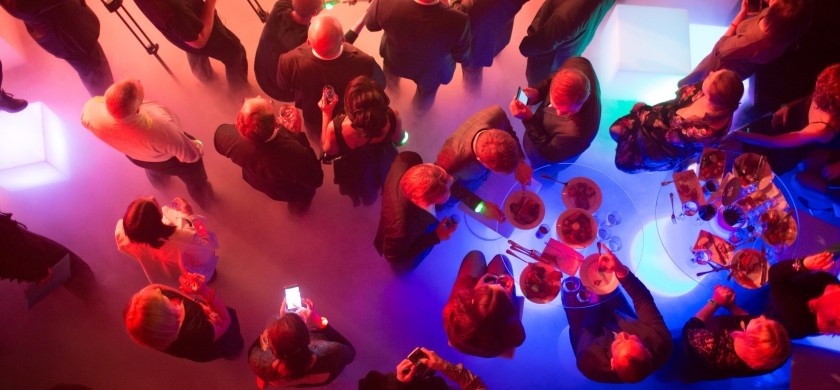
Going to a football game is an exciting experience for anyone — whether an attendee is a die-hard, rocking face paint type of fan or a casual fan just there to enjoy the stadium. As exciting as football stadiums and games can be, fans are constantly craving ways to make the event even more enjoyable and original.

In recent years, the use of stadium-specific mobile apps has emerged as a new technological trend to improve stadium experiences for fans. Apps act as somewhat of a modern-day event program — a place to obtain all of the information needed to have a good time and get the most out of a visit to the stadium.

These apps also offer an opportunity to communicate and connect directly with fans, offering them deals and discounts, showing different statistics, and fostering a positive community element to the fandom. Let’s take a look at the specific benefits of football stadium apps.

Five Key Benefits to Football Fan Apps

Five Key Benefits of Football Fan Apps

Although by no means an all-encompassing list, each of these five features of football stadium apps provide massive utility to dedicated and casual football fans alike, while also offering key benefits to those hosting the events.

Streamlining and Personalizing Fan Stadium Access With Digital Tickets

Football stadium apps allow fans to use a digital ticket when they enter the stadium. It’s incredibly easy and convenient as it helps fans save on wait time when arriving — but perhaps more importantly, digital tickets cut down on unnecessary waste costs for stadiums.

Moreover, digital tickets give stadiums a direct line of access to the fan, meaning that teams can interact with their fans after they enter the stadium. Apps can help facilitate sending fans a personalized greeting, making their experience feel personalized and unique. They can also show an interactive map of the arena or offer directions to the fans’ seats, allowing for seamless navigation throughout the stadium. Having these modern features can help to ease visitors’ stress while getting settled in for a game and make the entire experience more enjoyable and memorable for fans.

Using Apps for Ordering Food at a Stadium

Let’s be honest — what’s a trip to a sporting event without a big hot dog or your favorite beverage? A stadium food app can help ease the waits that fans can face while trying to get refreshments.

By skipping physical lines, fans are able to enjoy the game without feeling like they’re wasting their time standing around, thinking about plays they might miss. An app for ordering food at the stadium is a game-changer — no pun intended.

In addition to helping quell down on wait times, these apps can also help promote concession sales within the stadium. As they order online, more fans can access concession facilities at once — increasing the potential of maximum revenue.

Checking Scores and Statistics Around the League

Imagine a fan having a personalized scoreboard in their pocket — following their favorite players and rivals, their own personal experience tailored to the information they want and desire. This kind of inclusive access is a key feature of what stadiums apps can provide.

People who attend games are typically deeply involved in their fandom — and those are the types of fans who obsess over scores and statistics. Through the football stadium mobile app, teams are able to provide immediate updates on what’s going on in the game and across the league, allowing fans to be fully immersed in the experience.

Watching Breathtaking Highlights

The stadium experience goes beyond tracking stats – fans want to watch highlights of their favorite plays by their favorite players. Before the world of stadium apps, if a fan missed the replay of a play on the scoreboard, they had to wait till they got home and watch a replay on SportsCenter.

With football stadium apps, teams have a direct line to their fans to provide highlights in a timely manner, allowing them to endlessly relive the moments they just witnessed on the field. These apps allow fans to not only have a better sense of what’s happening on the field but also see how the rest of the world is viewing the game.

Sharing Stadium Pictures and Memories

What is a fandom but a big community — and a stadium provides the opportunity for that community to gather. Everyone is decked out in their favorite gear, from customized swag to vintage jerseys, interacting with fellow fans young and old. These interactions foster fans to take photos and remember their time in the stadium.

A football fan app encourages this behavior further, and provides a direct line to upload photos to the team and stadium. Fans can take selfies or photos of each other and post them to the group community — potentially putting themselves on the big screen, or on the team’s social media itself.

Teams are nothing without their fans. Providing a platform through a stadium app to share pictures and memories shows respect for that community and encourages them to gather and come back.

Powerful WiFi Is the Foundation for the Football Stadium App Experience

Powerful WiFi for Football Stadium App

Of course, none of these engaging experiences can happen without a strong foundation. In the case of football stadium apps, a strong WiFi connection is vital to making any of this work. Ordering food, watching highlights, sharing memories — each of the features that stadium apps provide are impossible without the proper internet connection.

In fact, smart stadiums are industry-leaders in network connectivity, showing convention centers how they can transform their own experience through smart solutions. With such potential, stadiums need a WiFi provider they can trust.

Leverage Stadium WiFi Solutions

We provide WiFi solutions with the stadium and fan in mind, offering a robust and innovative system that keeps people connected, fostering a community of fandom through technology. Our solutions are scalable to stadiums of all sizes, built from the ground up for your specific needs.

Looking to implement stadium apps yourself? Get started on implementing your foundational stadium WiFi and contact us today.

How Venues Adapt for Indoor and Outdoor Concert WiFi

When people think about WiFi access, they often think about connecting their phones or laptops to networks at home, work, or somewhere like a coffee shop. However, an often overlooked situation is the logistics of curating WiFi systems for live events with a high volume of attendees, such as concerts and music festivals.

For concerts and other live events, WiFi access is crucial for both performers and audiences alike. Venues have adapted their approach and now install WiFi systems and smart technologies that can handle the large numbers of users and network traffic expected during a major event.

Read on to discover the many ways in which WiFi is being used at concerts, both indoors and outdoors, and to learn about some of the considerations venues need to make when curating their own WiFi infrastructures and smart technology systems.

Why Do Venues Need WiFi Services?

A venue’s primary source of income comes from booking successful events. In order to establish a loyal and returning customer base, venues must offer quality services that meet the needs of the promoters, performers, and attendees.

After all, happy customers are repeat customers. One of the best ways to keep your customers happy is to provide them with strong and stable WiFi access. Here are four reasons why your venue needs reliable WiFi services.

WiFi Is a Necessity for All Live Events

wifi is a necessity for live events

Most people nowadays love to share their life experiences on multiple social media outlets. Sharing photos and videos has become one of the strongest motivations for people to attend live events. Part of the draw of an artist or a concert includes the social capital attendees will gain from participating in the live event.

Music Fans are Willing to Pay for Live Coverage

Nowadays, people are willing to pay for live streams of events – from music performances, to Twitch gaming streams. As a tool to promote a larger audience, live streaming can provide a wonderful gateway for fans to participate, even when they are physically unable to attend – as the whole world learned during the Coronavirus pandemic.

Live Sports Events Require Massive Data Use

The average American consumes 3.64GB of data per day. Users within stadiums consume similar amounts of data — however, when you go to a live sporting event, the number of users increases exponentially. Stadium Tech Report found that on average, each user at Super Bowl LIV in Miami consumed 595.6 megabytes of data over the course of the game — adding up to 26.42 terabytes of total data consumed.

As you can see, having a reliable and stable WiFi connection is now a requirement for all types of live events. Performers and live coverage event promoters expect it, and attendees demand it.

WiFi Services Allow More Monetization Opportunities

A common practice among many businesses is to offer customers the ability to log in to their WiFi networks in exchange for some personal information, or to watch an advertisement clip. The revenue opportunities that venues can take in during an event attendees’ WiFi login process is a major factor to consider.

Opportunity to Collect Customer Data

When customers log in to your venue WiFi, you can collect useful contact information like their name and email address. The data is extremely valuable, as it allows you to quickly create a database of potential customers you can reach out and market to for future events, provided you seek customers’ consent before doing so.

The login process is a perfect opportunity to engage with your attendees and gain insight into their profiles and interests. Through the consumer login process, and consistent with your privacy policy, which you should make available to customers, you can gather information such as the types of devices used to connect to WiFi and leverage the interests of individuals to target advertising for upcoming events. This process is also helpful in creating and supporting and anticipating guests’ needs.

With this data, you can offer more personalized content and experiences to enhance the entire live event experience.

Offer Partnerships With Event Promoters

Events and artists make a big chunk of their revenue from selling merchandise. The WiFi login portal page for your event is an excellent platform from which to advertise and sell merchandise.

There’s partnership potential where a venue might help the artist or event planner to market and sell their merchandise through its WiFi login page — a great way to generate additional revenue for the venue while also providing value to the event promoter.

Cross-Selling and Upselling Events

Another way to monetize your venue WiFi is cross-selling and upselling current and future events. Today, most event sales and purchases are accessible online — so if someone is attending a concert at your venue, you can use the opportunity to upsell them on VIP tickets or exclusive online merchandise. Or, if they’re attending a conference, you can cross-sell them on future events that might interest them.

Increased Marketing Partnership

By offering WiFi services, you are opening up your venue to increase marketing partnership opportunities. Businesses always look for new and innovative ways to reach their target audiences. You can provide businesses with the ability to brand their login page, advertise their products and services, and even offer coupons and discounts.

WiFi Services Can Help Venues Run Efficiently

Every business owner knows that controlling costs is one of the keys to running a successful operation. There are many different ways to save money by pairing various smart technology functions with your venue’s WiFi system.

IoT Enablement Smart Technology Tracking Features

When a customer connects to a venue’s WiFi network, the venue can track that customer’s movements and behavior. This information can help venue managers understand what areas of the venue are used the most, what times of day are busiest, and even how long customers spend in each area.

Using Tracking Features to Improve Customer Experience

The information gathered from tracking a customer’s location can be used to adjust and improve the overall customer experience. For example, if a venue sees a high amount of foot traffic in one area compared to another, they may decide to move some of their furniture or displays around to encourage more traffic in the less popular area.

On the other hand, if they see that customers are only spending a few minutes in one area but much longer in another, the venue may decide to add more seating or make other changes to encourage customers to spend more time in that location.

Helping Venues Save Money

WiFi services can also help venues save money by reducing energy costs. Many newer routers and access points come with energy-saving features that can make a big difference to your bottom line.

For example, some devices will automatically power down when they’re not in use or go into standby mode when there’s no activity. These features could lead to savings on your electric bill each month.

How Can Venues Provide Sufficient WiFi Coverage?

how can venues provide wifi coverage

One of the most common complaints from event attendees is that they can’t get a good WiFi signal. It is crucial for venues to consider how they can ensure strong, reliable WiFi that can handle many users at once. There are many factors that are essential for a venue to be able to provide good WiFi coverage.

High Bandwidth

One of the most important factors for good WiFi coverage is high bandwidth. Higher bandwidth means more data can be transferred per second, which is essential for many users who may be streaming video or working on tasks requiring a lot of data transfer.

Multiple Skillfully Placed Access Points

Another vital factor is multiple skillfully placed access points. Having multiple access points ensures that there are no dead spots in the coverage area and that all users can connect to the network regardless of where they are in the venue. This feature is crucial for outdoor concert WiFi installation in particular, due to the fact that it can be challenging to place access points in optimal locations while ensuring they remain protected from the elements.

Appropriate Channel Width

For multiple access points to work well together at a venue, they must be configured with appropriate channel widths. Channel width refers to the amount of spectrum available by the Access Point. A wider channel width means more data can be transferred, and the network can support more users. Wide channels are crucial to allow for the transfer of large amounts of data and the high numbers of users at event venues.

Captive Portals

Finally, captive portals are essential for ensuring only event-goers have access to your network. Captive portals are landing pages that are displayed to users when they try to connect to a network. They typically require users to log in or register before they can gain access to the internet. This system prevents outsiders from hijacking your bandwidth and ensures your WiFi connection is dedicated to only your event attendees, performers, and employees.

Update Your WiFi System Professionally

A strong WiFi system is no longer a luxury for businesses — it’s a necessity. In areas like stadiums, arenas, and other concert halls or venues, people constantly use their devices for everything from work to streaming entertainment, sharing their experiences, and connecting with others. If your venue doesn’t have a reliable WiFi system to accommodate those needs, you risk losing out on potential customers.

We understand that every business is different, so we work with each of our partners to create a tailor-made solution that meets their specific needs and budget. Whether you need to upgrade your existing system or install a new one from scratch, we can help to generate a solution. Contact us today to learn more about our services.

How IoT Technology Can Minimize Common Fan Safety Concerns in Stadiums

Protect Fans in Stadiums Using Innovative IoT Safety Technology

The use of IoT technology in stadiums can play a significant role in promoting fan safety at sporting events and other live performances. By implementing capable IoT technology, stadiums can take considerable steps to improve and promote venue security amidst common concerns.

Using IoT Technology to Diminish Fan Safety Issues in Stadiums & Venues

addressing common stadium safety concerns using IoT

Live events at stadiums require a great deal of coordination to ensure events proceed without any technical problems and that the safety of spectators is not compromised. Unfortunately, there are several ways that things can go wrong, putting everyone in the stadium at risk.

Game Disruption Due to Fights in the Stands

One of the most common disruptions during sporting events are fights that break out among fans in the stands. While security personnel can do their best to keep an eye on things, it often takes more work to spot a potential fight before it happens. As a result, safety at sporting events has always been a concern for stadium managers.

How IoT Technology Can Protect Against Fights in Stands

IoT solutions like video surveillance and crowd analytics can help stadium personnel identify potential fights before they start. Video surveillance cameras equipped with facial recognition software can identify known troublemakers in a crowd and alert security to their presence.

Crowd analytics can also use data from various sources, including social media, weather reports, and ticket sales, to predict when and where problems are likely to occur. By being proactive and using IoT technology to identify potential threats, stadium personnel can help prevent fights from happening in the first place.

Game Disruption Due to Fans Rushing the Field

Another common disruption during live events is when fans rush to the field or the stage during the event. While this may seem like harmless fun, it can often lead to severe injuries for both fans and players. In some cases, it can even lead to property damage as fans try to tear down equipment in their excitement.

How IoT Technology Can Protect Against Fans Rushing the Field

By installing sensors around the perimeter of the field, court, and stage, stadium personnel can be alerted as soon as someone tries to breach the security barrier. This gives them time to intervene and stop the person before they enter the “safety zone” where the performance or the game occurs. Additionally, by using data from previous games, crowd analytics can predict when and where fans are most likely to try and rush the field so that security can be increased in those areas.

Game Disruption Due to Audience Accidents

Accidents happen. But when they happen at a sporting event or live performance, they can often disrupt the game and cause delays while emergency personnel respond. Safety during events is difficult to manage because of the many people in attendance. In the past, it was up to the surrounding audience to notify security or emergency personnel of an accident. But with IoT technology, that’s all about to change.

How IoT Technology Can Protect Against Audience Accidents

With IoT technology, stadium personnel can quickly identify when someone has fallen and needs assistance. IoT-enabled sensors can be placed throughout stadium concourses and stairwells that detect when someone has fallen down. This information is then relayed to a central command center where emergency personnel can be dispatched immediately. This safety feature helps ensure that accidents are dealt with quickly and frees up security personnel who would otherwise have been called upon to respond.

Game Disruption Due to Weather Emergency Events

Mother Nature doesn’t always cooperate with event planning. Severe weather strikes during a live event can often lead to delays or even cancellations as spectators seek shelter from the storm.

How IoT Technology Can Protect Against Game Disruption to Weather Emergency Events

With IoT technology, stadium personnel now have a way to monitor weather conditions in real-time and take action accordingly. By installing sensors around the stadium that measure wind speed, precipitation levels, and lightning activity, venue staff can get an early warning when severe weather is on its way. This information can then be used to decide whether to delay or cancel the event — decisions that could help keep spectators safe from harm’s way.

Game Disruption Due to Illegal Entrances

A major problem that stadium owners face is illegal entrances. This refers to people who either sneaked into the stadium without paying, bought forged tickets, or purchased tickets but have yet to sit in their assigned seats. Not only does this cause problems for venue security, but it also disrupts the game for paying fans trying to watch from their seats.

How IoT Technology Can Prevent Illegal Entrances to Stadiums

One of the most common stadium safety tips is incorporating IoT technology to track people as they enter the stadium. By installing sensors at all entrances, security personnel can quickly identify anyone who has entered the stadium without a ticket. The facial recognition information can then be used to eject the individual from the premises.

Game Disruption Due to Slow Audience Entry

Another problem that often plagues stadium owners is slow audience entry. This occurs when fans take their time entering the stadium, causing congestion and delays. This can be inconvenient for fans trying to get to their seats in time.

How IoT Technology Can Prevent Slow Audience Entry

IoT can help with this problem by providing real-time data on crowd density. Fans can be processed quickly and efficiently by having multiple electronic check-in points and online verification options. It not only helps to reduce congestion, but it also helps to improve security by allowing stadium personnel to track who is entering the premises. Venue owners can also leverage electronic signage to help first-time attendees find their seats more quickly and efficiently.

Game Disruption Due to Parking Lot Congestion

The parking lot is often one of the most congested areas of a stadium on game day. It can be the primary reason preventing fans from getting to their seats in time. Having all audience vehicles stuck in a car-to-car traffic jam in search of available parking spots can also increase the risk of causing car accidents.

How IoT Technology Can Prevent Game Disruption due to Parking Lot Congestion

IoT technology can alleviate this problem in several ways. By installing automatic license plate scanners at all parking lot entrances and exits, patrons can enter and exit venue lots without stopping to purchase and validate their parking tickets. Online reservation systems can also help fans find and reserve parking spots in advance. This not only helps to reduce congestion, but the feature also helps to improve security by allowing stadium personnel to track who is entering and exiting the premises.

In addition, security cameras can provide real-time data on parking lot conditions. By installing sensors in the parking lot, stadium personnel can quickly identify areas of congestion and direct fans to available parking spots. All these features eliminate vehicles from idling in the parking lot and help minimize the risk of accidents.

Game Disruption Due to Cyber Attacks

With more and more devices connected to the internet, stadiums are increasingly vulnerable to attacks from hackers. These attacks can disable scoreboards, concession stands, and other critical systems, such as WiFi log-in portals, blocked online verification processes, and electronic check-in stations. These attacks prevent an event from beginning on time and put customers’ personal data at risk — the FBI even advised athletes at the 2022 Beijing Olympics to bring a temporary cell phone to avoid cyber attacks including data theft and installation of malware.

How IoT Technology Can Protect Against Cyber Attacks

To avoid this problem, stadium owners can use IoT technology to monitor their systems for signs of intrusion. Having multiple layers of web security protections, such as WPA3 encryption, antivirus programs, firewalls, and a secure two-factor log-in portal to access the stadium’s WiFi system can significantly reduce the risk of a successful cyber attack.

Other Benefits of IoT Technology for Stadiums

benefits of iot technology for stadiums

In addition to the safety benefits, IoT can bring several other advantages to stadiums. They can help elevate the customer experience by providing interactive experiences, such as digital signage that can guide fans to their seats or offering order-ahead and in-seat concessions ordering.

IoT can also help stadiums save money by reducing energy consumption through smart lighting and temperature control systems. In the long run, these benefits can help stadiums improve their bottom line and become more sustainable businesses. And most of all, it can also help generate extra income and provide data to improve better usage of the venue space.

The Leading IoT Technology Provider to Stadium Events

We understand that the safety of your fans is always a top priority. That’s why we offer a variety of IoT technology solutions specifically designed for stadiums and other large venues. From managed WiFi to self-service kiosks, we have the answers you need to keep your fans safe and informed.

With over 40 years of experience in the hospitality and entertainment businesses, we have the knowledge and expertise to help make your stadium a safe and enjoyable place for everyone. Our team of experts will work with you to assess your specific needs and develop a customized solution that meets your unique requirements. Contact us today to learn more about how we can help make your stadium safety a priority for your fans.

Ready to Transform Your Hospitality Venue?

Get a Consultation with one of our Hospitality Technology Experts!

This field is for validation purposes and should be left unchanged.
Full Name(Required)
Choose Your Venue / Interest Type: