6 Hotel Accessibility Features Leveraging Technology


Hotel accessibility has long been framed as a compliance obligation, yet many hotels still lag behind in fully accommodating people with disabilities (PWD).
The Americans with Disabilities Act (ADA) was officially enacted in 1990. Thirty-five years later, a 2025 NPR survey found that the gap between what compliance requires and what PWD guests actually experience remains wide. As a common example, wheelchair users routinely arrive at hotels to discover unavailable “accessible rooms,” beds too high to transfer in and out of and front desks they can’t see over.
Technology is continuing to bridge the gap for PWD guests. NFC-enabled door locks, voice-controlled room environments and accessible booking platforms give hotels the tools to build genuine accessibility into every stage of the guest journey. What each of these solutions needs to perform reliably is a network infrastructure strong enough to carry them all.
Common Challenges in Hotel Accessibility
The opportunity cost of failing to accommodate the PWD market is high. Travelers with disabilities spent nearly $50 billion on U.S. travel in 2024, and the global accessible travel market is projected to reach $126 billion by 2030.
Despite decades of regulation and growing demand, most hotels still fall short of true accessibility. These are the gaps guests encounter most often.
- Inaccessible physical environments: Guests in wheelchairs or with mobility aids have trouble getting around because of narrow doorways, high countertops, and the absence of ramps or lifts. Hotel accessibility should be a design standard, not an afterthought, even for properties that have recently been remodeled.
- Inadequate accessible room inventory: Many properties don’t have enough accessible rooms, and when the inventory runs low, those rooms are often the first to be reassigned. Guests with disabilities often arrive to find that their reserved accessible room isn’t available and that there are no other rooms that are similar.
- Digital and booking barriers: A 2025 AudioEye report found that travel websites have some of the worst digital accessibility problems of any industry. If a guest has a visual or cognitive impairment, an inaccessible booking experience can make it impossible for them to get a room before they even arrive.
- Beds and furnishings at inaccessible heights: Bed height is one of the most common problems for guests who need to move from a wheelchair. Standard furniture arrangements don’t account for the different physical needs of guests.
- Poor emergency and safety communication: Standard fire alarms and emergency alerts mostly use sound cues, which don’t work for guests who can’t hear well. Properties that haven’t specifically invested in inclusive safety infrastructure still don’t have many visual and tactile alert systems.
- Undertrained staff: Simply having the right physical infrastructure doesn’t make a hotel experience accessible. Even well-equipped properties fall short when front-line staff don’t know how to help guests with different needs in a respectful way.
Tech-Enabled Hotel Accessibility Features to Consider
The technology to build a genuinely accessible hotel experience already exists. These six features represent some of the most impactful and practical solutions available today.
1. NFC-Enabled Door Locks
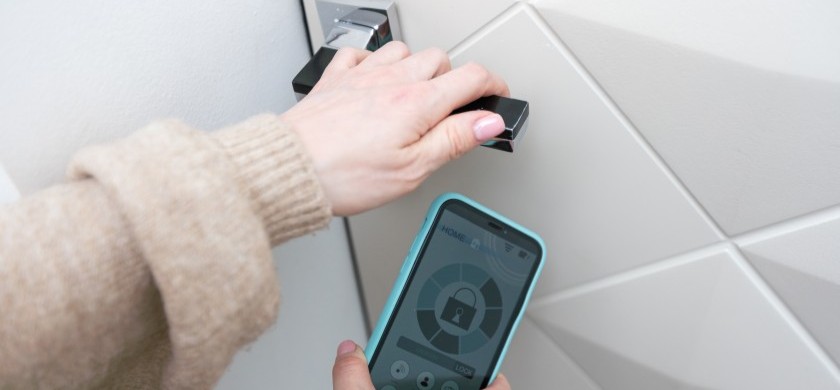
Guests can open their doors with Near Field Communication (NFC) door locks by tapping their smartphones or a wearable device. The tap-and-go feature makes it easier for guests with limited dexterity, arthritis, or motor impairments versus using a keycard or gripping a handle.
Hotels can also send you digital keys before you get there. Guests can skip the front desk check-in process and go straight to their room. This is good for people in wheelchairs who might have trouble accessing regular check-in counters. The system relies on real-time credential authentication, which means a stable network infrastructure is essential.
2. Adjustable Beds
One of the most common problems for guests with mobility issues is bed height and the lack of adjustability. A study by MMGY Global found that 52% of travelers with mobility issues say that hotel beds are too high for them to safely get out of a wheelchair.
Height-adjustable beds fix this problem right away. Motorized controls let guests lower the bed to the level of a wheelchair for transfers and then raise it back up to a comfortable sleeping height on their own. A guest who can take care of their own comfort is a guest who feels respected, not just taken care of.
3. Voice-Assisted Lighting and Heating
For guests with visual impairments, limited mobility or conditions affecting fine motor control, adjusting a thermostat or locating a light switch can be a genuine challenge. Voice-assisted room controls remove that friction entirely.
With a voice command, guests can adjust lighting intensity, set room temperature and close curtains without touching a surface. They can also request housekeeping or room service hands-free. These systems run on cloud-managed platforms and require stable, low-latency network connections to respond accurately and consistently.
4. Room Control Smartphone Applications
In-room control apps give guests a single interface to manage nearly every aspect of their stay, from lighting and temperature to TV channels and do-not-disturb status. For guests with hearing impairments, cognitive disabilities or limited mobility, an app replaces dependency on physical controls scattered throughout the room.
The best implementations integrate with a hotel’s property management system. Staff gain full visibility of guest needs and preferences, and response times improve as a result. Every connected function in the room depends on a reliable WiFi network that reaches every corner of the property without interruption.
5. Fire Alarms for Guests with Hearing and Visual Impairments
Standard fire alarms rely almost entirely on sound. For the roughly 15% of American adults who experience some degree of hearing loss, an audio-only alert is not adequate protection.
ADA-compliant visual and tactile alert systems close this gap. Strobe lights and bed-shaker devices connect wirelessly to a hotel’s existing fire alarm system without requiring full building rewiring. When an alarm is triggered anywhere in the property, a wireless signal activates the visual and tactile alerts inside accessible rooms. Every guest receives the same opportunity to evacuate safely.
6. Online-Integrated Booking Software
For travelers with disabilities, the guest experience starts during the early stages of research and planning. According to a survey by Open Doors Organization, 81% of travelers with disabilities used the web for travel planning, and almost half (48%) relied on it to identify and book accessible accommodations.
Digitally accessible booking platforms equip guests with the ability to filter accommodations by specific accessibility features. Additionally, such platforms provide detailed room descriptions and complete reservation booking capabilities using assistive technologies like screen readers.
The ADA requires hotel reservation systems to be fully accessible and user-friendly to guests with disabilities at all times. More than just checking a compliance box, properties that meet that standard resonate with this significant and loyal segment of travelers that many hotels are still neglecting.
Accessibility Runs on Connectivity
Every feature on this list shares a common requirement. NFC locks need to authenticate credentials in real time. Voice controls need a low-latency connection to respond accurately. Room apps need seamless WiFi to function the way guests depend on them to. Visual and tactile alert systems need a reliable signal to activate at the moment it matters most.
Accessibility technology is only as dependable as the network beneath it. A dropped connection does not just disrupt a guest’s comfort. For guests who rely on these features to navigate their stay safely and independently, it can mean something far more serious.
Blueprint RF designs and manages WiFi solutions built for the demands of the hospitality industry. When the technology your guests depend on needs to work without fail, the network powering it needs to be built that way from the start.
Contact Blueprint RF for more information.